
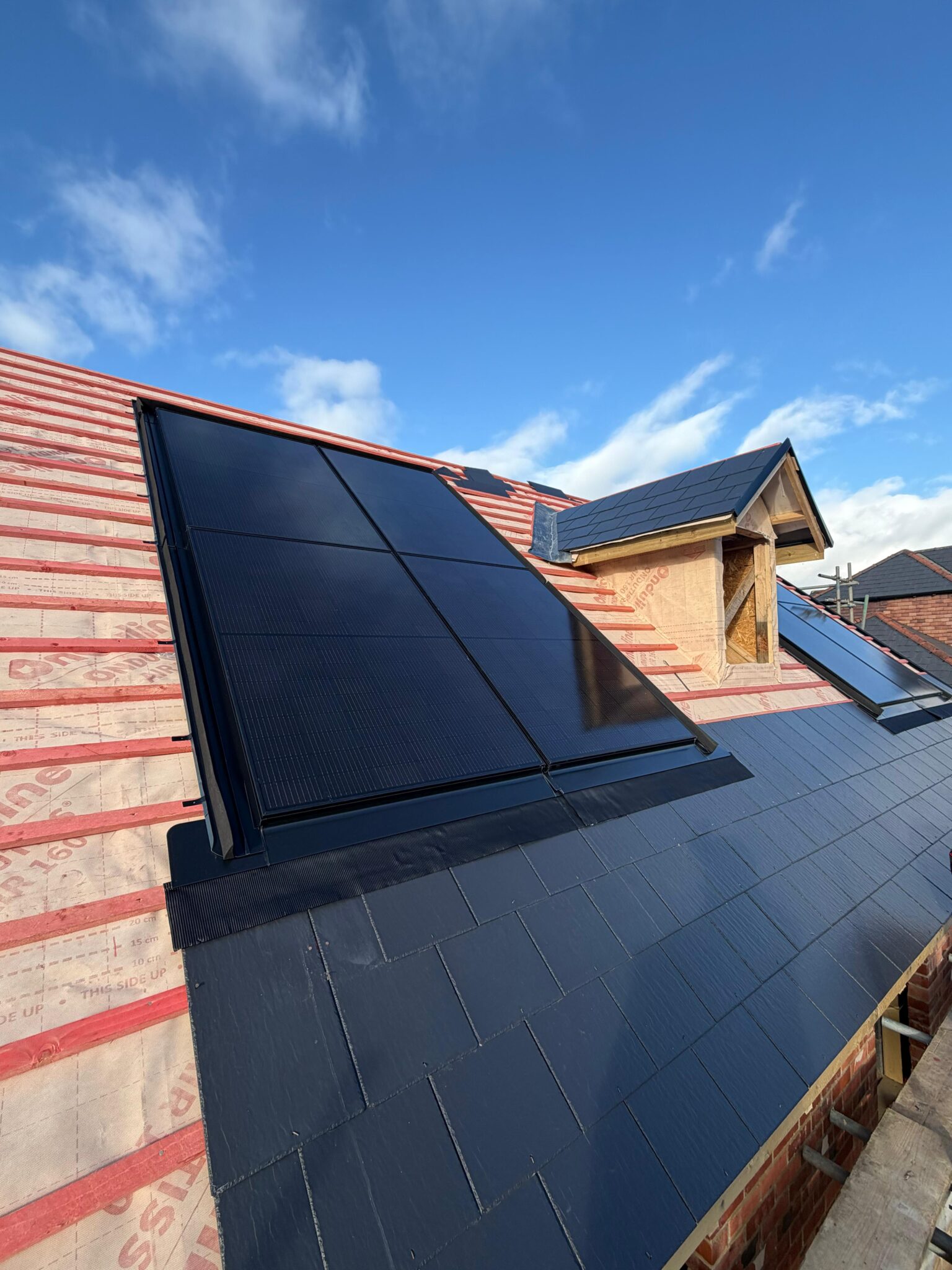
How many solar panels does a home actually need? It is one of the first questions people ask when considering solar, but there is no reliable answer based on bedroom count alone. The right number depends on how much electricity you use, the output of the chosen panels, the usable area and orientation of your roof, shading and how your energy needs may change. This guide explains how a UK homeowner can arrive at a sensible estimate—and why the final design should be tailored to the property.
Key takeaways
What does “how many panels” really mean?
Solar panels are sold with a power rating in watts (W). The complete array is normally described in kilowatt peak (kWp): its maximum rated output under standard test conditions. Ten 450W panels, for example, make a 4.5kWp array because 10 × 450W equals 4,500W.
That does not mean the system continuously produces 4.5kW. Actual output changes with sunlight, temperature, roof direction, angle, shading and system losses. Annual generation is measured in kilowatt hours (kWh), the same unit shown on an electricity bill. Understanding the difference matters:
- W or kW describes power at a particular moment.
- kWp describes the rated peak capacity of the solar array.
- kWh describes the amount of electricity generated or consumed over time.
If you would like a broader introduction to the technology, read how solar panels work.
A sensible sizing process
The four main factors that determine panel count
Two neighbouring homes can need different systems. One household may use most electricity during daylight hours, while another plans to charge an EV and wants a larger array. A useful design brings the following factors together.
1. Electricity consumption
Use at least 12 months of bills or smart-meter data to find annual consumption. Monthly direct-debit cost is less useful because it combines unit rates, standing charges and usage.
2. Usable roof area
The roof’s total size is not the same as usable area. Edges, ridges, valleys, rooflights, chimneys, vents and safe installation clearances affect the final layout.
3. Direction and shading
An unshaded south-facing roof is ideal, but east- and west-facing arrays can work well. Energy Saving Trust says east- or west-facing systems tend to generate around 15–20% less than directly south-facing ones.1
4. Future demand
An EV, heat pump, electric hot-water system or growing household could increase consumption. Designing only around today’s bill may miss a cost-effective opportunity.
Shading deserves particular attention. Trees, chimneys and nearby buildings may reduce output, sometimes more significantly than a less-than-perfect roof direction. An installer should assess shading through the day and across the seasons, then explain any proposed use of optimisers or microinverters.2
How to make a first estimate
You can make a useful first estimate before arranging a survey. It will not replace a system design, but it will make quotations easier to understand.
Step 1: find your annual electricity use
Look for a figure labelled annual consumption or estimated annual consumption on your electricity statement. Use actual meter data where possible. If you have recently moved, renovated or changed the way you heat or travel, explain that to the installer because the historic figure may no longer represent normal use.
Step 2: consider when you use electricity
Solar generates during daylight, so timing matters as well as the annual total. Home working, appliance use and EV charging during the day may increase direct use of solar electricity. A household that is usually out during daylight may export more unless it shifts flexible loads or adds battery storage.
Step 3: estimate available roof space
Energy Saving Trust says a typical 4.5kWp system with around 12 panels may occupy roughly 20–30m².1 Actual module dimensions vary, and panels cannot necessarily fill every visible square metre. A survey should confirm dimensions, roof condition, structural suitability, access and a compliant arrangement.
Step 4: divide the target array size by panel power
If a designer proposes a 4.5kWp array using 450W modules, the calculation is 4,500 ÷ 450 = 10 panels. The same 4.5kWp target would require more panels if each module had a lower wattage. This is why comparing quotations by panel number alone can be misleading.
Indicative panel numbers by property type
House type can indicate how much roof space may be available, but it does not reveal the household’s electricity use. Energy Saving Trust provides the following rough roof-capacity examples: four panels for a mid-terrace, eight for an end-terrace or semi-detached home, 12 for a small detached home and 16 for a large detached home.2 These are useful visual guides—not recommended system sizes.
| Illustrative property | Rough panel capacity | Example at 450W each | What must still be checked |
|---|---|---|---|
| Mid-terrace | About 4 panels | About 1.8kWp | Consumption, roof layout and shading |
| End-terrace or semi-detached | About 8 panels | About 3.6kWp | Usable roof faces and future demand |
| Small detached | About 12 panels | About 5.4kWp | Expected generation and self-consumption |
| Large detached | About 16 panels | About 7.2kWp | Grid connection, budget and export assumptions |
The kWp figures above are simple arithmetic examples using 450W panels; they are not quotations or output forecasts. Panels come in different ratings and dimensions, while a roof may accommodate a different layout. The better question is not “How many panels does this house type get?” but “What design makes best use of this property for this household?”
Should the array match all your annual electricity use?
Not automatically. Generating the same number of kWh in a year as the household consumes does not mean the home is self-sufficient. Solar output is highest during daylight and generally stronger in summer, whereas consumption continues at night and may rise in winter. You can export surplus electricity at one time and import from the grid at another.
A well-sized system therefore considers expected annual generation, how much solar electricity is likely to be used directly, how much may be stored, and how much may be exported. The best economic balance varies with the installation price, electricity tariff, export arrangement and household behaviour. See our guide to how much solar panels could save for the wider financial picture.
It can still make sense to use much of a suitable roof, especially where electricity demand is expected to rise or marginal installation costs are favourable. Conversely, filling every possible space is not automatically best if extra panels sit in heavy shade, face poorly, trigger avoidable complexity or generate electricity the household cannot use or export economically.
How batteries, EVs and heat pumps affect sizing
Future electrification can materially change the design. It is worth discussing likely changes at the first survey rather than treating each technology in isolation.
Battery storage
A battery does not create electricity, but it can store surplus daytime generation for later use. Battery capacity and solar-array size should be considered together: an oversized battery may not charge regularly, while a small battery may fill early on bright days. A combined design can estimate likely generation, consumption and cycling. If panels are not currently possible, read whether you can install a home battery without solar panels.
Electric vehicles
An EV can add significant electricity demand, but the benefit from solar depends on when the vehicle is at home and able to charge. Daytime solar charging may increase self-consumption. Overnight charging will normally use the grid or stored energy, so tariff strategy and battery capacity also matter.
Heat pumps
A heat pump increases electricity demand, particularly in colder months when solar generation is lower. Energy Saving Trust notes that a home will still need grid electricity when panels are not generating; matching annual totals does not remove the seasonal and daily mismatch.4 Solar can contribute, but it should not be presented as continuously powering the heating system.
What a good solar quotation should show
Before comparing prices, check whether each installer is proposing the same capacity and working from credible assumptions. A clear proposal should enable you to understand:
MCS standards require the performance and self-consumption estimates to be communicated before the contract is awarded.3 These estimates should help comparison, but should never be represented as guaranteed output. For an overview of installation choices, visit ProSolar’s solar panel installation page.
Common solar-sizing myths
Is your roof ready for a solar survey?
You do not need to complete your own technical assessment, but the following information will help an installer produce a more relevant design:
Most domestic rooftop solar in England is often permitted development when the relevant conditions are met, but listed buildings, designated areas and unusual proposals may need additional consideration.5 Planning rules differ across the UK, so the position should be checked for the property rather than assumed.
Frequently asked questions
How many solar panels does the average UK home have?
Energy Saving Trust currently describes an average system of around 4.5kWp, typically using about 12 panels and 20–30m² of roof area.1 Your appropriate system may be smaller or larger.
How many panels make a 4kW solar system?
It depends on module wattage. A 4kWp target could use ten 400W panels, for example. Nine 450W panels would total 4.05kWp. The installer must also select compatible electrical equipment and confirm the layout.
Can I install panels on an east- or west-facing roof?
Yes, many east- and west-facing roofs are suitable. Energy Saving Trust says they tend to generate around 15–20% less energy than a directly south-facing system, although the exact result depends on the site.1 A split east-west array may also spread generation across more of the day.
Should I cover the whole roof with solar panels?
Not necessarily, but it is worth pricing sensible options. Compare extra cost with forecast generation, self-consumption, export and future demand. Heavily shaded or awkward areas may add little value.
Do I need a battery with a larger solar system?
No. Solar works without a battery. Storage may increase the share of generation used at home, but it adds cost and should be sized around likely surplus and evening demand.
Can I add more solar panels later?
Often yes, but it can require changes to the inverter, electrical design, roof layout, grid connection and certification. If expansion is likely, tell the installer at the outset so the first system can be planned with that possibility in mind.
Find the right solar system for your home
ProSolar can assess your electricity use, roof, shading and future plans before recommending a system size. You will receive a design based on your property rather than a generic panel count.
Request a free quoteReferences
- Energy Saving Trust, Solar panels: costs, savings and benefits explained.
- Energy Saving Trust, Solar panel installation: a step-by-step guide.
- MCS, MIS 3002: The Solar PV Standard, Issue 6.0 (2026).
- Energy Saving Trust, Your heat pump questions answered by our experts.
- GOV.UK, Renewable and low carbon energy planning guidance.
This is a great reminder that financial planning isn’t just about numbers; it’s about aligning your money with your life goals. Physician Lifecycle Planning can help you make the most of your earning potential while ensuring you’re also prioritizing your well-being and quality of life.
Comments are closed.